+91-98777-81556 info@sepalhealthcare.com

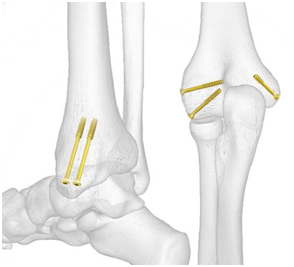
4 mm Cannulated Screws are used in fixation of fractures, fusions, and osteotomies of bones. Since these screws come in various sizes, they can be used for small as well as large bones, across different parts of the body. These screws are cannulated, i.e., have a hollow central shaft.

Cannulated Cancellous (CC) screws are used mainly for treatment of metaphyseal fractures. Cannulated screw systemsoffer preliminary reduction of fractures, provide percutaneous screw fixation and result in stability. These screws help in reduction of the total duration of surgery, enable accurate screw placement and reduce the occurrence and chances of errors.


The main advantages of CC Screws includes:

Cannulated Cancellous Screws are used for treatment of fractures of small bones as well as small bone fragments.

Following are some of the advantages of the CC Screws -

Preparation:

The instruments need to be cleaned intraoperatively, using the cleaning stylet to avoid accumulation of debris in the cannulation.This also helps in avoiding possible entanglement of the instruments with guiding wire. Post the operation, the instruments need to be cleaned using the stylet as well as the cleaning brush.

The flutes of the CC screws are self-tapping and self-drilling, hence pre-drilling and pre-tapping of these screws prior to surgery may not be necessary in most of the cases. However, if in certain cases the pre-drilling and pre-tapping is required, 2.7mm cannulated drill bits may be used which comes in the set.

Measuring Screw Length:

The tapered end of the cannulated screw measuring device is slid over the guide wire, and the scale at the end of the guide wire is read to determine the required screw length.

Inserting the Guide Wire:

A 1.25 mm guide wire is inserted through the 2.7 mm / 1.25 mm double drill drive for the required depth. Once the placement of the wire is checked and confirmed, the drill sleeve has to be removed.

In the places where soft tissue coverage is very low, the cannulated countersink can be used to form a break for the screw head. Even though countersinking is purely optional, in some cases it helps in insertion of screws.

Screw Insertion:

The screw of appropriate length is placed over the guide wire. With the help of a cannulated hexagonal screwdriver, or a screwdriver shaft, and a holding sleeve, the screw is inserted. After the insertion, the guide wire is discarded.

X
Open chat
Hello , How Can We Help You ?