+91-98777-81556 info@sepalhealthcare.com

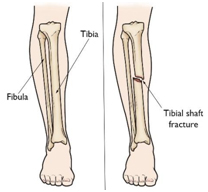
Tibia or the shinbone is another long bone in our body, and is situated between the knee and the ankle. The lower leg consists of 2 bones, one is tibia and the other is fibula. The bigger and longer one among the two is called tibia. It is yet anotherstrong bone.

Being a strong bone, it requires a substantial force to break a tibia. Many times, during the tibia fractures, the smaller bone called fibula gets broken as well.


Symptoms of Tibia Fracture:

The typical symptoms of a tibia fracture include a sharp pain in the leg, immediately after the injury. The fracture can be characterized by an inability to walk, swelling and bruising, numbness or tingling sensation in the feet and toes, and visible deformity in the affected leg. In severe cases, the broken bone might even protrude out through the skin.

Causes of Tibia Fracture:

Tibia, being a strong bone, requires a very strong force to get broken. So usually a high-energy collision such as a motor vehicle accident may lead to a fracture in the tibia. Sometimes, the tibia may get fractured as a result of sports injury as well.
Tibia fracture is diagnosed by an X-ray, MRI or CT scan.

Tibia fractures are divided into following types –

Types of Tibia Fractures:

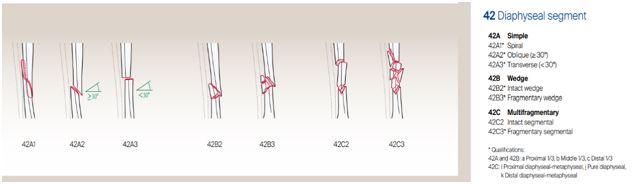
A. Based on the location and pattern of the fracture, tibia fractures are divided into the following types:

B. The general classification of tibia fractures is as mentioned below:

a) Transverse fracture : this refers to the break that is a horizontal line going across the tibial shaft.

a) Stable fracture : in this type of fracture, the broken ends of the tibia are aligned and in proper position.

b) Oblique fracture : in this type of fracture, the break happens at a slanting line across the tibial shaft.

b) Displaced fracture : in this type of fracture, the broken ends of the tibia are not aligned and are out of their correct place.

c) Spiral fracture: as the name suggests, here the line of the break girdles the tibial shaft, like a spiral.

c) Closed fracture : in this type of fracture, the skin adjoining the fracture is undamaged.

d) Comminuted fracture: in this type of fracture, the bone chips into three or more pieces, and is very unstable.

d) Open fracture: here, the broken end of the tibia tears through the skin, making it protrude out. This implies there are damages to the tissues and ligaments surrounding the tibia.

These plates are used for the fractures in the radius, as per the AO guidelines.

Treatment:

Non-surgical Approach -

Usually, surgery is considered to be the best way to treat a tibia fracture. In rare cases, where the broken tibia has ends that are properly aligned in place, without any damages, a non-surgical approach may be considered. This involves placing of a splint, with adjustable straps,onto the affected leg.

Surgical Approach:

This involves the following methods –


External Fixation: In this method, metal pins and screws are placed externally above and below the site of fracture, and these pins and screws are attached to a bar outside the skin. This structure helps to hold the bone in position.

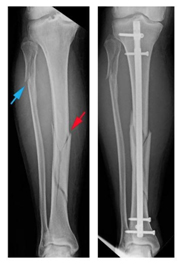
Intramedullary nailing:

In this method, a rod made of titanium is inserted into the canal of the tibia. This is the most commonly used procedure;however, this process is not advised in case of children and adolescents, as the bones are still growing.
Plates and screws:

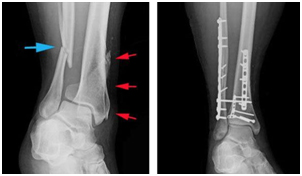
In this method, the broken bones are first repositioned into their normal position and held together with screws and plates fixated to the outer surface of the bone.

X
Open chat
Hello , How Can We Help You ?