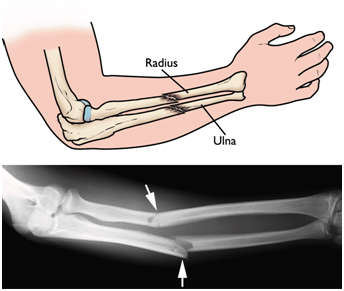
A forearm is the portion of the arm situated between the wrist and elbow. Forearm is made of two bones that are relatively parallel to each other, namely radius and ulna.
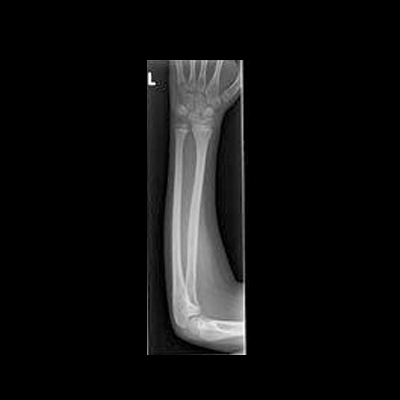
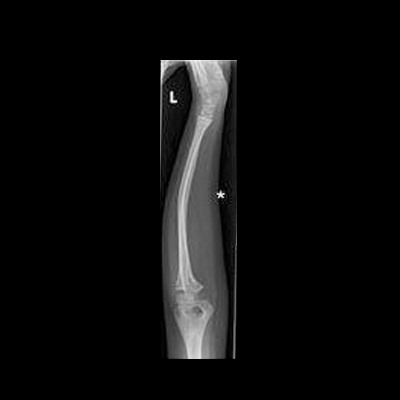
Forearm fracture refers to the condition in which the bones in the forearm, i.e., the radius and ulna are either broken or cracked. The break or crack could be located anywhere across the forearm – near to the wrist, at the middle or towards the end of the bones near the elbow.
Symptoms of Forearm Fracture:
The fracture in the forearm can be easily diagnosed. It is accompanied with severe pain in the arm, which worsens with mild movement in the wrist or elbow. It is also associated with mild or severe swelling and bruising in the forearm. There might also be visible abnormalities in the arm such as a bend in the arm or wrist. Some experience unresponsiveness in the wrist, accompanied with difficulty in movement of arm and wrist.
The diagnosis usually involves a CT Scan, and X-Ray.
The most common causes of forearm fracture in adults are motor vehicle accidents, sports injuries, and falls from heights. It may also occur resulting from a severe twist of the upper arm. In case of children, the injuries may occur due to accidents during playing, falling on an outstretched arm and falling from heights.
Types of Forearm Fracture:
Fracture in the Radius (Radial Fracture)
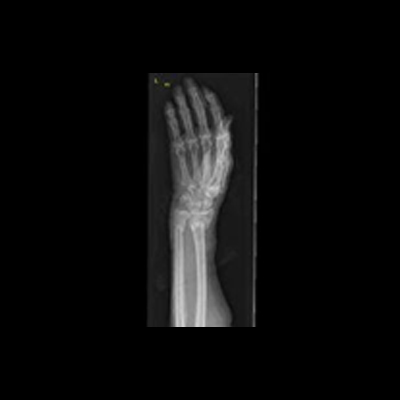
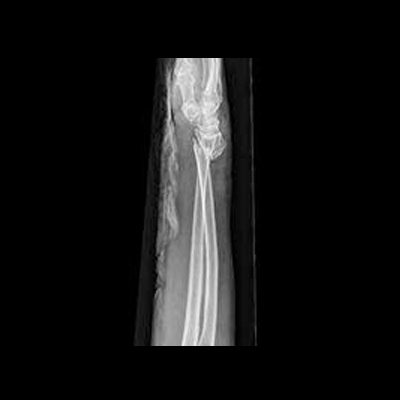
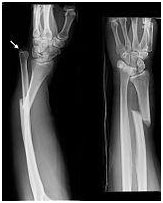
Radial fractures may occur on their own, or resulting from the disruption of the joint of ulna and radius, located at the wrist. This is also known as Galeazzi fracture.
AO Classification of Radial Fracture:
AO Classification:
Fracture in the Ulna (ulna Fracture)
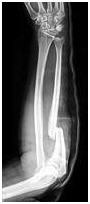
A fracture in the Radius is usually the result of defence against a head injury – while trying to protect the head from an injury. When the ulna gets dislocated from the Radius during the fracture it is called Monteggia fracture.
Treatment of Forearm Fracture:
Forearm fractures can be treated using surgical as well as non-surgical approaches. The non-surgical or conservative approach requires placing the bones together using a cast or a brace. This is possible only if the broken bone is not out of place.
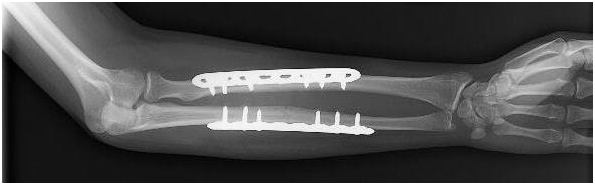
The surgical approach involves two procedures – Internal fixation and external fixation with the help of screws and plates. In internal fixation, the bones are joined together with surgical screws and plates that are fixed at the outer surface of the bone. Another way of joining the broken bones is through specially designed rods that are inserted through the marrow.
The broken bones of the forearm are held in position by plates and screws while they heal.
In External fixation, specially designed metal pins are placed on the skin, inserted through the bone right above and below the fracture. These metal pins and screws are fixed to a bar outside the skin.